Posts Tagged ‘Newspapers’

How will end of print journalism affect old loons who hoard newspapers?

Tuesday, March 9th, 2010

God, I love the Onion.

Daily Diversion: Old school news

Wednesday, February 3rd, 2010

And you thought today’s newspapers were archaic?

Daily Diversion: Bon Jovi reads the paper?

Thursday, January 21st, 2010

Paid for by the National Association of People Who Give Love a Bad Name.

Cool commercial: Web and print can play nicely together

Monday, January 18th, 2010

A nice twist to the print vs. Web conflict.

(Hat tip: E&P in Exile)

The San Francisco Panorama: The newspaper that’s not a newspaper

Monday, December 28th, 2009

I just got my copy of the San Francisco Panorama, the hefty, 320 page, one-time-only newspaper that feels as vast as the bridge pictured on its cover. The brainchild of David Eggers, the Panorama is intended to remind us what a newspaper can be — a skillfully written, stunningly designed product that grabs readers, surprises them and tells them something new about the world.

The problem is, it takes time — and money — to produce those kinds of stories. The Panorama is proof of this problem — it took five months to produce a single edition.

In the real world, the challenge facing newspapers is that they must be interesting every single day. And really, they’re only interesting some days. It’s hard to report and write an investigative story. It takes talent to write a colorful yarn that hooks readers and doesn’t let them go until the kicker. Readers have to decide if it’s worth the cost of a subscription to get those kinds of stories only some of the time.

I’m looking forward to reading the Panorama. But let’s be honest — it’s not a newspaper, a publication put out by frenetic, talented people on tight deadlines, who must often crank out stories about press conferences or humdrum public meetings to fill up the paper, but who also occasionally and miraculously smack us in the head with a powerful story that we never saw coming.

Newspapers: The must-have, hand-held accessory of 2009

Wednesday, December 2nd, 2009

Here’s a clever video that pokes fun at iPhone commercials and reminds us about the “amazing full-color display” of old-school newspapers.

The Web is amazing. It gives journalists a way to produce interactive graphics and videos, post breaking news and share conversations with readers.

But newspapers are easier to read. Newspapers offer huge photos and compelling lay outs. And you don’t need a Wi-Fi hot spot to use newspapers.

iPhones and newspapers are both cool. Just in different ways.

(h/t mUmBRELLA and crindalyn)

Daily Diversion: Satisfy your smoke hunger

Tuesday, November 24th, 2009

Chesterfield

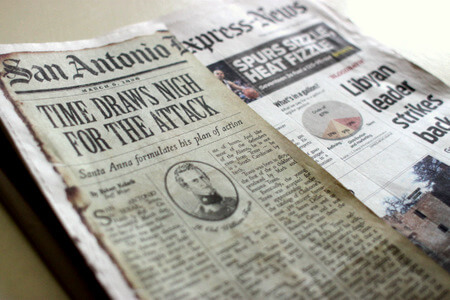
Check out this Chesterfield Cigarette ad published in the San Antonio Express newspaper in 1919:

Chesterfields satisfy your smoke-hunger just as a drink of cold water satisfies your thirst. They go straight to your smoke-spot.

Anita Baca, a photo editor at the Express-News, brought in a gigantic volume of aged, crinkly newspapers from 1919. The articles were interesting — lots of headlines about U.S. troops engaging Mexican forces on the border. But I was drawn to the ads. They offered a taste of what it was like to live in the old days. For 10 cents, you could buy a pack of cigs to satisfy your “smoke hunger.”

Ten cents sounds cheap — and it is. In today’s dollars, that’s about $1.20 adjusted for inflation, which is way less than the cost of a pack of cigarettes today with all the taxes tacked onto it. It gives you an idea of how prevalent and cheap smoking was in the good old days, before they knew what was causing “smoke hunger.”

E-N reader sees the future of news?

Thursday, October 29th, 2009

San Antonio Express-News

San Antonio Express-News

Express-News reader Jamie Blount might have shown us the future of newspapers in this letter to the editor today:

While I don’t like the dismal news about how newspapers have fallen on hard times, I like the way the San Antonio Express-News has confronted the problem. I read the complete edition of the SAEN online Monday through Thursday and then read the print edition Friday, Saturday and Sunday. This arrangement gives me the flexibility to keep up with the news in ways that are conducive to both my work and personal schedules.

While I-10 replaced U.S. 90, the airplane replaced the train and TV replaced radio, people continue to use those old modes of travel and communication. Probably, the same could be said about the Internet replacing the newspaper. The old reliable is still in use because it offers attractive, viable alternatives to the modern.

Blount makes an interesting point. Weekends are when a lot of people have time to sit down and fully digest the newspaper. Weekdays, not so much. But online traffic spikes. An Associated Press story today examined how newspapers are cutting back print operations on less profitable days such as Mondays, when advertising is thin.

“In an industry struggling with bankruptcy filings, diminished advertising and the exodus of many readers to the Internet, about 100 U.S. newspapers have either reduced the number of days they publish or gone to the Web entirely,” wrote reporter Jim Salter. This is not entirely a bad thing, the story says, since the newspapers save money from reduced production costs. The papers publish later in the week with editions that are their real cash cows.

So maybe Blount is on to something.

How two newspapers teamed up to cover a nuclear plant

Monday, September 14th, 2009

As South Texas deals with a seemingly never-ending drought, San Antonio Express-News Environmental Reporter Anton Caputo teamed up with Austin American-Statesman Reporter Asher Price for this story about the water supply that cools nuclear reactors at the South Texas Project in Matagorda County.

The utility companies of both cities own a stake in STP, which creates a situation where both newspapers are examining a proposed expansion of the nuclear facility. Instead of competing like newspapers in a bygone golden era, both papers are collaborating in an era of shrinking newsrooms and budget cuts.

In this case, the final product was interesting. Sunday’s story by Anton and Asher was a good read. The reporters pulled together some useful information about how much crucial coolant the plant needs and whether the Colorado River can provide it. There’s an interesting map produced by the Statesman that shows the top water users along the Colorado River, giving readers a sense of the demand for water. And Express-News graphic artist Mike Fisher created this cool animation explaining why water is important for a nuclear plant.

The Express-News and the Houston Chronicle, both owned by Hearst Corp., already share news resources, but the Express-News has rarely teamed up so extensively with a newspaper owned by a different company. The Statesman is owned by Cox Newspapers. The last time I can think of an example of such cooperation was in the late 1990s, when reporters with the Express-News and the Sarasota Herald-Tribune were often in contact during the coverage of Sheila Bellush, a mother of quadruplets who had lived in San Antonio, moved to Florida, and was killed in a murder-for-hire plot hatched by her ex-husband, Allen Blackthorne.

We seldom, if ever, wrote stories or shared bylines with the folks in Sarasota. We mostly shared information and court documents, which made sense for a story that was playing out in two cities a thousand miles apart.

Maybe this will be a rising trend among Texas newspapers as newsrooms shrink, but hopefully they collaborate for valid reasons, not because it sounds good in an editorial meeting. The journalists need to be crystal clear about what, exactly, the collaborators bring to the table.

Old news in newspapers? Not always

Sunday, September 13th, 2009

Interesting letter-to-the-editor today in the San Antonio Express-News written by Linnea Schlobohm, who sums up one of the main themes of this blog better than I ever could:

After reading Brian Chasnoff’s beautifully crafted story on the San Antonio River, “Paradise Lost to Progress” (Front Page, Sept. 6), I remembered a recent TV comment predicting the demise of newspapers because everything in them is old news.

I beg to differ. Chasnoff did more than give me a headline and some statistics. He pulled me into a compelling story and, more importantly, presented vivid images of the river, its history and its potential future.

That’s not old news. That’s news in-depth. And that’s what we need when we’re making decisions about finances, resources and quality of life. Long live good reporters and good newspapers.