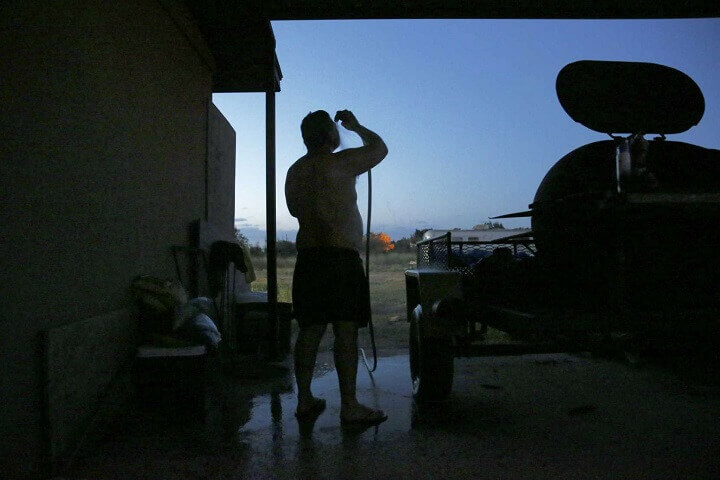
Mexican authorities arrest “La Barbie”

September 1st, 2010 by John Tedesco

In January, Express-News Reporter Jason Buch profiled Edgar Valdez Villarreal, a U.S. citizen from Laredo who had risen through the ranks of a Mexican drug cartel. In high school, Valdez Villarreal was a jock who got the nickname “Barbie” for his light-colored eyes and hair. Years later in Mexico, he was poised to become a ruthless drug boss.

This week, Valdez Villarreal was arrested in Mexico and NPR featured an interesting interview with Jason yesterday about Villarreal. You can hear a Mexican ballad that extols the virtues of the drug lord, and how he’s such an intelligent businessman. Great stuff.

Uncovering hidden ties between state Rep. Jose Menendez and a housing developer

August 30th, 2010 by John Tedesco
News story by Karisa King

After Reporter Karisa King began writing about the complicated world of tax breaks for housing developers — and how those incentives are being abused — tipsters told her to check out state Rep. Jose Menendez.

Karisa did. And what she found out was published on the front page of last Sunday’s San Antonio Express-News:

After the development firm NRP Group LLC lost its second bid for tax credits to finance an affordable-housing project on the city’s West Side, an influential ally intervened in the company’s cause.

State Rep. Jose Menendez took the lectern at the Texas Department of Housing and Community Affairs and urged board members to fund the San Juan Square II project, a 144-unit apartment complex that would replace blighted public housing. …

What Menendez did not tell the board at the meeting was that the development represented something else: a financial boon for the company he works for, Stewart Title, which had received $91,000 for issuing title insurance on the project’s first stage, and landed nearly all of NRP’s business on affordable-housing deals.

Payouts from the San Juan developments were among about $1.8 million paid to Stewart Title from NRP housing deals since 2003, records show.

Since joining the Legislature in 2000, Menendez has been one of the most outspoken supporters of NRP and other developers in the affordable-housing sector.

At the same time, the San Antonio Democrat has ascended the ranks of Stewart Title to become vice president for commercial development in the company’s national division.

Karisa said she spent six weeks working on the story about Menendez.
It was easy to confirm that he worked for Stewart Title. But his ties to the company raised a hard-to-answer question: How much money did Stewart Title make from the housing deals? That’s not something you can answer by Googling it.

Sometimes journalism is simply the act of quantifying something. You might know the broad outlines of a story very early in the reporting process, but you have to figure out how to fill in the gaps.

If you’ve ever bought a house, you know real-estate transactions churn out tons of paperwork. Normally most of those records are private. But because tax breaks were involved in the housing deals Karisa was looking at, the real estate records were considered public information, open to anyone who asked.

Karisa found the fees paid to Stewart Title by driving to Austin and reading the records for housing projects that receive tax breaks, which are filed at the Texas Department of Housing and Community Affairs in Austin. “I spent two days just going through boxes and boxes of documents,” Karisa said.

As she read through the files, Karisa typed key information such as the title fees into a simple Excel spreadsheet. After days of work, she was able to add up the fees for each housing project: A grand total of $1.8 million in title fees were paid to Stewart Title.

What did Mendendez have to say about that? Check out the whole story, it’s a great read.

Edwards Aquifer + $130 million highway project = federal lawsuit

August 26th, 2010 by John Tedesco

The biggest single stimulus project scheduled to be built in Bexar County is a new highway interchange between traffic-clogged Loop 1604 and U.S. 281 on San Antonio’s far North Side. The project is estimated to cost $130 million, with $80 million coming from federal stimulus funds that must be spent by 2015.

But the site sits on the environmentally sensitive Edwards Aquifer recharge zone, the primary source of San Antonio’s drinking supply — and the source of San Antonio’s fiercest debates about pollution from urban sprawl tainting the aquifer.

Here’s a time line of events leading up to a lawsuit filed Wednesday by Aquifer Guardians in Urban Areas that could jeopardize the project. The lawsuit accuses transportation agencies of failing to protect the Edwards Aquifer.

In a way, it’s history repeating itself. The highway intersection was the site of one of the very first controversies involving the aquifer, when developers in the 1970s wanted to build a “super mall” near the location that sparked a petition and referendum by concerned residents who tried to halt the development.

All these years later, the dust hasn’t settled.

Time magazine: Not for kids anymore

August 24th, 2010 by John Tedesco

The interviews with the kids are classic.

Warning labels for journalists — and bloggers

August 23rd, 2010 by John Tedesco
Journalism Warning Label

Painfully funny “journalism warning labels” created by British comedian Tom Scott are going viral. The stickers say things like, “Warning: This article is basically just a press release, copied and pasted.” Scott says he’s been posting the stickers on the free papers in London. And he’s making it possible for everyone to do this. You can download the stickers for free. Fans have translated them into 11 languages.

“It seems a bit strange to me that the media carefully warn about and label any content that involves sex, violence or strong language — but there’s no similar labeling system for, say, sloppy journalism and other questionable content,” Scott explained on his blog.

Scott’s making a salient point, but I don’t see why it should be limited to journalists. You can find rehashed press releases on blogs, too. That’s what a block quote is for. And contrary to what Scott claims, when I get an unverified tip, I don’t hang up the phone and start writing a story; I check it out. But some bloggers will simply run with it, then add the caveat that they’re waiting for confirmation. If it’s not true … oh well.

I’m not pointing this out to thump my chest and say the mainstream media should be trusted over everything else. But lately I’ve been noticing similarities between news organizations and many blogs claiming to be different from the media. For example, the Washington press corps is often accused of practicing pack journalism. Whenever some official announcement is made at the White House, everyone jumps on it and writes the same thing.

What’s so different about pack journalism in Washington and pack journalism in the blogosphere? Whenever an official announcement pops up from Google in my RSS reader, minutes later tech blogs are parroting it. Pick your niche; the same thing is happening.

The lesson here is that a blogger faces similar pressures and time constraints as a traditional reporter. It’s easy to make sloppy mistakes, to follow the pack, to rehash stale news.

The real challenge, for both blogs and the media, is doing something different, original, and enlightening for readers.

(Photo credit: Tom Scott)

Why is open government such a big deal?

August 18th, 2010 by John Tedesco

Some readers — and government officials — wonder why journalists are so nosy and make such a big deal about getting access to government records. Sure, transparency matters. But why make such a big fuss if an agency wants to withhold e-mails or something. Who cares?

Here are five shining examples of why this pesky-open government thing matters.

Last week, the Freedom of Information Foundation of Texas held its annual conference in Austin and announced the winners of the Gavel Awards, which go to journalists who produced stories that shed light on the legal system. A common thread runs through all these stories: They relied extensively on public documents, and uncovered important, previously unknown problems and issues in the community.

So if you think public information isn’t really that big a deal, check out the winning stories:

  • Steve Thompson and Tanya Eiserer of The Dallas Morning News discovered the Dallas Police Department was under-counting serious crimes, creating the perception that the city was safer than it actually was. The reporters uncovered the story by examining piles of police reports.
  • Jeremy Roebuck and Jared Janes of the McAllen Monitor relied on public documents to tell the tale of how Hidalgo County was struggling to pay for millions of dollars in indigent defense costs. The reporters discovered the county’s system cost more per capita than any other urban county in Texas.
  • Leslie Wilber of the Victoria Advocate revealed how an innocent man was jailed for 62 days based on a questionable “scent identification lineup” overseen by a dog handler and his bloodhounds. The obscure law-enforcement technique answers to no laws or regulations and critics call it junk science. But the lineup is still admissible as evidence in court.
  • Cindy V. Culp of the Waco Tribune-Herald used court data to analyze the track record of a district attorney running for office. The news stories gave voters a clearer picture of a controversy surrounding how many criminal cases were dismissed.
  • David Schechter and Mark Smith of WFAA-TV uncovered how illegal immigrants who are accused of felonies in the United States — including murder — are routinely deported back to Mexico and set free.
  • Somebody explain to me again why public information doesn’t matter.

    Daily Diversion: Baby time lapse

    August 16th, 2010 by John Tedesco

    Hard to believe Pete was born a year ago. At the hospital, Jen’s dad suggested we take a picture of him every day to make a time lapse video. Here’s the result.

    I’m glad we took the time to do this because the video shows just how fast Pete is growing up. It’s also cool to see how Pete began smiling and interacting with the world.

    If you want to do this kind of project, all you need is a camera, a tripod, video editing software, and the patience to stick with it. There’s no way you can take a picture every single day — you might be out of town, or the baby might be sick, or you might just simply forget. But I’d suggest taking a picture every day in the first few months at least. That’s when they really pack on the pounds. As you can see, it didn’t take long for Pete to become a cute little butterball.

    Happy birthday, Pete.

    Watchdog blog roundup for 8-12-10

    August 12th, 2010 by John Tedesco
    linotype keys

    What others are saying about watchdog journalism:

  • Carl Bernstein: The “Golden Age” of Investigative Journalism Never Existed | The Big Think
    Watergate reporter Carl Bernstein isn’t concerned about the state of investigative journalism today — he’s concerned about the state of today’s readers.
  • The tyranny of the daily 10 percent | The Evolving Newsroom
    If money grew on trees and journalists could produce all the top-notch stories they wanted, would the audience read them all? Would it make a difference in society? Or would readers still scan the headlines and read roughly 10 percent of those stories?

  • The glacial pace of justice | Washington Post
    Cold cases that the Justice Department have successfully prosecuted relied on the work of investigative reporters.
  • Mainstream news media: Not dead yet | The Christian Science Monitor
    Journalism must find some middle ground where illuminating investigative pieces and Mel Gibson telephone call mash-ups can coexist.
  • Kachingle hopes ‘social payments’ can help fund content | MediaShift
    “If advertising alone isn’t going to support all the online journalism and content sites, and pay walls will just turn readers away, perhaps there’s another solution …”
  • What stimulus projects are being funded in Bexar County, and what’s the price tag?

    August 11th, 2010 by John Tedesco
    Construction workers on the Mission Reach of the River Walk

    Construction workers on the River Walk's Mission Reach

    Our latest story about the stimulus is about how much federal money is flowing to Bexar County, what kind of projects are being funded, and what will the lasting impact be?

    Stimulus money is fixing headstones at Fort Sam Houston National Cemetery, building new playgrounds, painting buildings at Lackland AFB, paying for 50 new police officers and reshaping the San Antonio River.

    It’s funding high-profile projects that will benefit future generations — and paying for obscure work that hardly will be noticed.

    Sometimes, it feels like the biggest beneficiaries of the Recovery Act are companies that make the outlandishly sized checks for ribbon-cuttings, where politicians frequently take credit for stimulus projects.

    But behind the photo ops are a large number of companies, government agencies, and nonprofit organizations that were awarded 775 grants and contracts in Bexar County worth more than $850 million, according to spending reports released last week by the Recovery Accountability and Transparency Board. Another $60 million in stimulus money is being loaned to local businesses.

    We’ve been spending a few months examining the local impact of the Recovery Act — past stories are here and here. I’ve also been bookmarking useful resources through Diigo — feel free to check out my real-time list of handy websites.

    For the latest story, we mostly relied on data you can download directly from Recovery.gov, the website of the Recovery Board. The data doesn’t have a “county” category, but you can match the zip code of each award with the zip codes of your county. If you’re simply interested in seeing what kind of stimulus projects are being funded in your county or neighborhood, the Recovery Board offers an interactive map that lets you drill down to the street level. Each stimulus project shows up as a dot — click on it to learn more details.

    Daily Diversion: Tighten Up

    August 10th, 2010 by John Tedesco

    “But he smells like ranch dressing …” Awesome jam and video by the Black Keys.